


Mary Pourebadi, Ph.D.


Dr. Pourebadi is a Lecturer in the Department of Computer Science and the Department of Management Information Systems at San Diego State University (SDSU).
She directs the Cognition, Adaptation & Reasoning for Embodied Artificial Intelligence (CARE AI Lab), which drives independent multidisciplinary research at the intersection of applied AI, robotics, and human–robot interaction (HRI) to design embodied AI systems that learn from real-world, human-centered data, and autonomously and adaptively engage with people in complex, real-world settings.
Dr. Pourebadi earned her Ph.D. in Computer Science and Engineering from the University of California, San Diego (UCSD), where she developed expressive and interactive robotic systems for healthcare and education. Her research develops multimodal, agentic, and embodied AI systems that can perceive, reason, and act reliably in real-world environments. With nearly over two decades of work across Computer Engineering and Computer Science, she has focused on bridging foundational AI research with deployable intelligent systems—particularly in robotics, healthcare, education, and socio-technical domains. Her central objective is to design explainable, trustworthy, and human-aligned AI that integrates perception, reasoning, and action while operating under real-world constraints such as latency, safety, realism, and data privacy.
Across her career, Dr. Pourebadi has built and deployed AI-driven robotic and intelligent systems (physical and virtual) that combine multimodal perception (vision, language, speech, sensors), adaptive control, large language and vision–language models (LLMs/VLMs), and edge–cloud AI infrastructures. These systems have been validated through peer‑reviewed publications, competitive awards, and real-world deployments in clinical training, rehabilitation, education, and human–robot interaction. Building on this foundation, her current work at San Diego State University (SDSU) consolidates these prior contributions into a cohesive, independent research program aligned with SDSU’s interdisciplinary AI vision and the mission of the James Silberrad Brown Center for Artificial Intelligence.
Dr. Pourebadi’s work has been recognized at premier robotics, computing, and healthcare venues, including the flagship ACM/IEEE International Conference on Human-Robot Interaction (HRI), ACM HEALTH journal, AAAI AI‐HRI, IEEE FG, RSS, IPCV, AHA, ICIS, HICSS, NDSS, and QRS. She is also the recipient of multiple honors recognizing leadership, mentorship, and community impact, including the ACM, NSF, CRA, UC San Diego, and repeated recognition at the ACM Tapia and GHC.
In addition to her research, Dr. Pourebadi teaches undergraduate and graduate courses in robotics, machine learning, AI for Business Applications, and advanced programming languages. She emphasizes hands-on, systems-oriented learning and mentors students across disciplines with a strong commitment to inclusive excellence and student-centered research.
EXPERIENCE AT A GLANCE
-
Interdisciplinary researcher with 20+ years of experience leading funded and applied research in multimodal, agentic, and embodied AI systems across robotics, machine learning, HCI, health informatics, and intelligent systems.
-
Active scholar with 25+ refereed publications, including journal and conference papers, abstracts, and posters.
-
Designed and deployed tens of physical and virtual robotic systems across instructional and research platforms.
-
Led and expanded high-impact CSE–industry and
cross-institutional academic partnerships to accelerate translational research and collaborative innovation.
-
Supervised 20+ master’s and undergraduate researchers in STEM projects and provided mentorship to 110+ students through structured outreach initiatives.
-
Leader and advocate for inclusive excellence, with 10+ years of sustained leadership in DEI initiatives, K–12 and Girls-in-STEM outreach, Women in Tech programs, graduate and undergraduate mentorship, and accessibility- and ethics-centered AI research.
-
Instructor of record for 2 academic years, with 12+ years of prior experience as a teaching assistant and mentor across undergraduate and interdisciplinary CS and MIS courses.
-
500+ students taught in Robotics, Machine Learning, Artificial Intelligence, and Advanced Programming Languages across interdisciplinary CS and MIS.
-
Builder and leader of high-demand, hands-on, project-based courses, including the design and operation of a 30+ robot instructional laboratory; courses consistently reach full enrollment with significant waitlists; supervised 5–9 instructional assistants per semester; implemented ABET-aligned curriculum design and assessment.
-
Demonstrated excellence in teaching and curriculum leadership, with strong median student evaluations of
4.7/5.0 in Robotics; 4.6/5.0 in Advanced Programming Languages, and strong validation from senior faculty peers.
-
Recognized nationally for leadership, mentorship, and community impact through multiple honors, including awards from ACM, NSF, CRA, UC San Diego, and repeated recognition at the ACM Tapia and GHC.

EDUCATION
Ph.D., Computer Science and Engineering, 2023
University of California San Diego (UC San Diego), CA
Dissertation: "Expressive, Interactive Robotic Patient Simulators for Clinical Education"
M.S., Computer Science, 2017
Kent State University (KSU), OH
Thesis: "A Deep Learning Approach for Blind Image Quality Assessment"
B.S., Computer Engineering, 2014
Alzahra University (AU), Tehran
Thesis: "Developing an Artificial Intelligence Algorithm for Tumor Detection in MRI Images of Breast"

TEACHINGS
Click on a course to learn more.

This course offers an active, hands-on learning experience to explore the fundamental building blocks of robots—motors, sensors, and algorithms.

A hands-on, application-driven Machine Learning course that blends core theoretical foundations with practical implementation and real-world problem solving.

The course retains the intellectual foundations of traditional AI while reorienting them toward modern, deployable, business-aligned AI architectures.

This course delves into the fundamentals and principles of high-level programming languages, covering formal techniques for syntax specification and addressing key implementation issues.

RESEARCH
Dr. Pourebadi directs The CARE Lab (Cognition, Adaptation & Reasoning for Embodied AI), where she leads ongoing independent research projects in robotics and embodied artificial intelligence. Her research also builds on prior work and collaborations across academic labs and interdisciplinary research centers, which inform the current directions of CARE Lab research.
CARE AI LAB RESEARCH


The CARE AI Lab (Cognition, Adaptation & Reasoning for Embodied Artificial Intelligence) conducts research at the intersection of robotics, multimodal AI, and intelligent agent design. The lab focuses on how embodied systems perceive, reason, and interact in real world environments, with students contributing through exploratory research in multimodal memory, adaptive dialogue, and socially aware robot control.
Click the next page to learn more about ongoing and emerging projects in The CARE Lab.
COLLABORATIVE RESEARCH
INDEPENDENT & COLLABORATIVE RESEARCH

James Silberrad Brown Center
for Artificial Intelligence

One line of collaboration was through the James Silberrad Brown Center for Artificial Intelligence (JSBC-AI), a pioneering interdisciplinary hub for applied and socially grounded AI research at SDSU. Through this center, Dr. Pourebadi worked closely with faculty in the MIS department on robotics and socially intelligent AI systems. In this context, she recruited students for the center and co-advised students on projects involving multimodal AI pipelines, human–robot interaction, and socially grounded data workflows.
The collaborative environment fostered by JSBC-AI directly shaped Dr. Pourebadi's research trajectory at SDSU by accelerating interdisciplinary exchange, student research engagement, and the translation of embodied AI research into applied socio-technical contexts. These efforts resulted in peer-reviewed publications in leading information systems venues such as ICIS and HICSS, and provided students with hands-on experience spanning system design, implementation, evaluation, and dissemination.
TEAM
Collaborators
Faculty collaborators who contribute expertise, mentorship, and interdisciplinary perspectives to projects.


Students
Graduate and undergraduate students contributing as instructional student assistants and volunteer researchers.


_edited.png)


Alumni
Former members who previously contributed as a team member and have since graduated or moved on to new academic or professional paths.


NEWS
Featured talks, media highlights, and public engagements showcasing research in robotics, embodied AI, and human-centered intelligent systems.
All Videos
All Videos
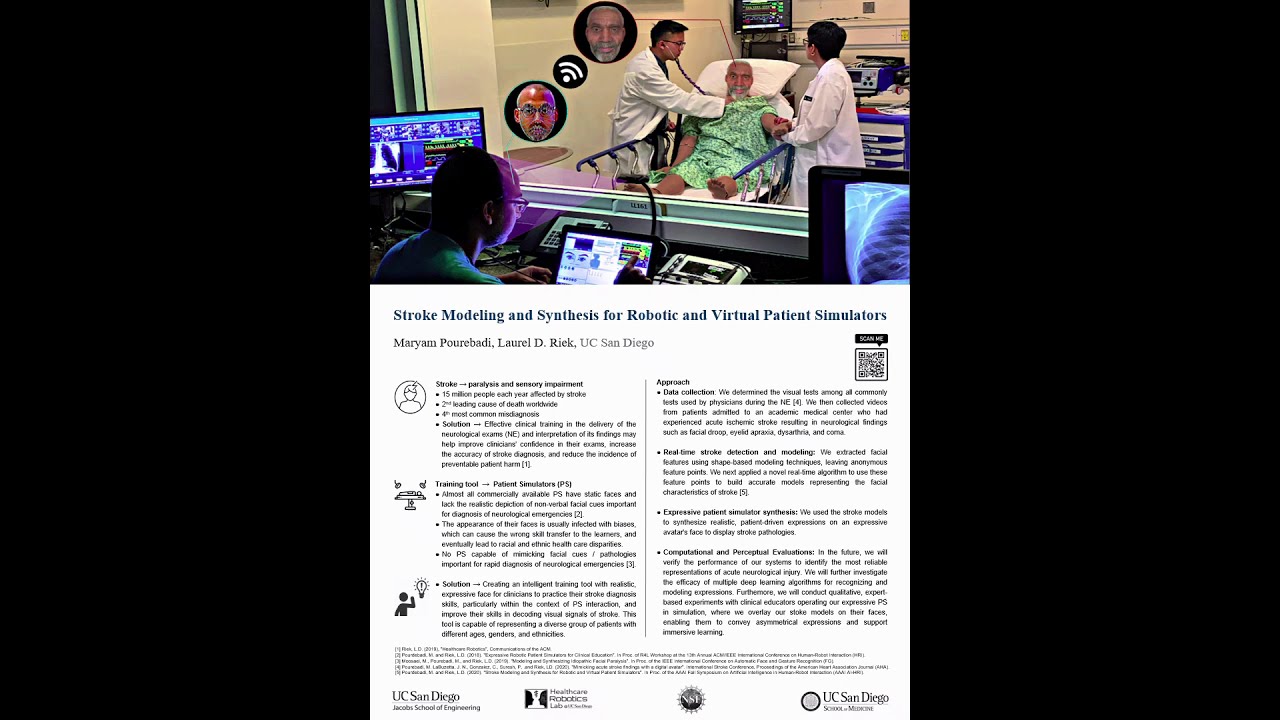
Maryam "Mary" Pourebadi gives a talk at the AAAI Fall Symposium on AI-HRI 2020

ND Professor Laurel Riek describes robotics research

Our robots wish you a Happy Halloween!

UC San Diego- Jacobs Graduate Student Council Award –August 2018: Maryam Pourebadi
GALLERY
Moments from classrooms, talks, robotics labs, hands-on work with robots, and innovation meetings.


PUBLICATIONS
Elkins, A., Singh, S., Pourebadi, M., Amadasun, U., Abhari, K. (2026)
"Designing Socially Grounded Data Pipelines for Training and Operating Socially Intelligent Robots: Challenges and Future Directions". Hawaii International Conference on System Sciences (HICSS).
Elkins, A., Singh, S., Pourebadi, M., Amadasun, U., Abhari, K. (2025)
"Training Socially Intelligent Robots with Large Behavior Models: Challenges, Strategies, and Future Research Opportunities". International Conference on Information Systems (ICIS).
Homayouni, H., Pourebadi, M., Dabhi, S. N., Nguyen, S. T., Badlani, P. P., Hashemi, M., Shirazi, H. (2024)
“Towards Comprehensive Functional Testing in ETL Processes: A Classification Framework and Empirical Validation on a Real-World Data Warehouse,” 24th IEEE International Conference on Software Quality, Reliability, and Security (QRS) [Acceptance rate: 23.81%].
Homayouni, H., Pourebadi, M., Shirazi, H. (2024)
"Federated Multimodal Medical Data Generation," The Network and Distributed System Security Symposium (NDSS) [Acceptance rate: 20%].
Pourebadi, M., Riek, L.D. (2022)
"Facial Expression Modeling and Synthesis for Patient Simulator Systems: Past, Present, and Future," ACM Transactions on Computing for Healthcare (HEALTH) journal 3(2), 1-32.
Kubota, A., Pourebadi, M., Banh, S., Kim, S., Riek, L.D. (2021) "Somebody That I Used to Know: The Risks of Personalizing Robots for Dementia Care," We Robot 2021. [Acceptance rate: 15%].
Pourebadi, M., and Riek, L.D. (2020)
"Stroke Modeling and Synthesis for Robotic and Virtual Patient Simulators," AAAI Fall Symposium on Artificial Intelligence in Human-Robot Interaction: Trust & Explainability in Artificial Intelligence for Human-Robot Interaction (AAAI AI-HRI).
Pourebadi, M., Gonzalez, C. G., LaBuzetta, J. N., Meyer, B. C., Suresh, P., Riek, L. D. (2020)
"Mimicking Acute Stroke Findings With a Digital Agent," International Stroke Conference (ISC), American Heart Association Journal (AHA ISC).
Ghayoumi, M., and Pourebadi, M. (2019)
"Fuzzy Knowledge-Based Architecture for Learning and Interaction in Social Robots'', AAAI Fall Symposium on Artificial Intelligence and Human-Robot Interaction: Service Robots in Human Environments (AAAI AI-HRI).
Moosaei, M., Pourebadi, M., and Riek, L.D. (2019)
"Modeling and Synthesizing Idiopathic Facial Paralysis'', IEEE International Conference on Automatic Face and Gesture Recognition (FG). [Acceptance rate: 20%]
Pourebadi, M., and Riek, L.D. (2018)
"Expressive Robotic Patient Simulators for Clinical Education," Robots 4 Learning workshop at the 13th Annual ACM/IEEE International Conference on Human-Robot Interaction (HRI).
Pourebadi, M., Pourebadi, M. (2016)
"MLP Neural Network Based Approach for Facial Expression Analysis," 20th International Conference on Image Processing, Computer Vision, and Pattern Recognition (IPCV). [Acceptance rate: 24%]
Ghayoumi, M., Khan, J., Pourebadi, M., Bauer, E., Hossain, A. (2016) "Follower Robot with an Optimized Gesture Recognition System," Socially & Physically Assistive Robotics For Humanity workshop at Robotics: Science and Systems (RSS).
ACKNOWLEDGEMENTS
I am thankful for the community and institutional support that has recognized my work in leadership, mentorship, and inclusive excellence through honors from the Association for Computing Machinery (ACM) Certificate of Recognition; National Science Foundation (NSF) Connections in Smart Health; NSF I-Corps Hub distinctions; recognition from Computing Research Association Women (CRA-W); the Outstanding Graduate Leader Award (UC San Diego Graduate & Professional Student Associations); VEX Distinguished Mentorship Certificate of Excellence; and multiple awards from the ACM Richard Tapia Celebration of Diversity in Computing (AMC Tapia) and the Grace Hopper Celebration of Women in Computing (GHC).


.png)


